
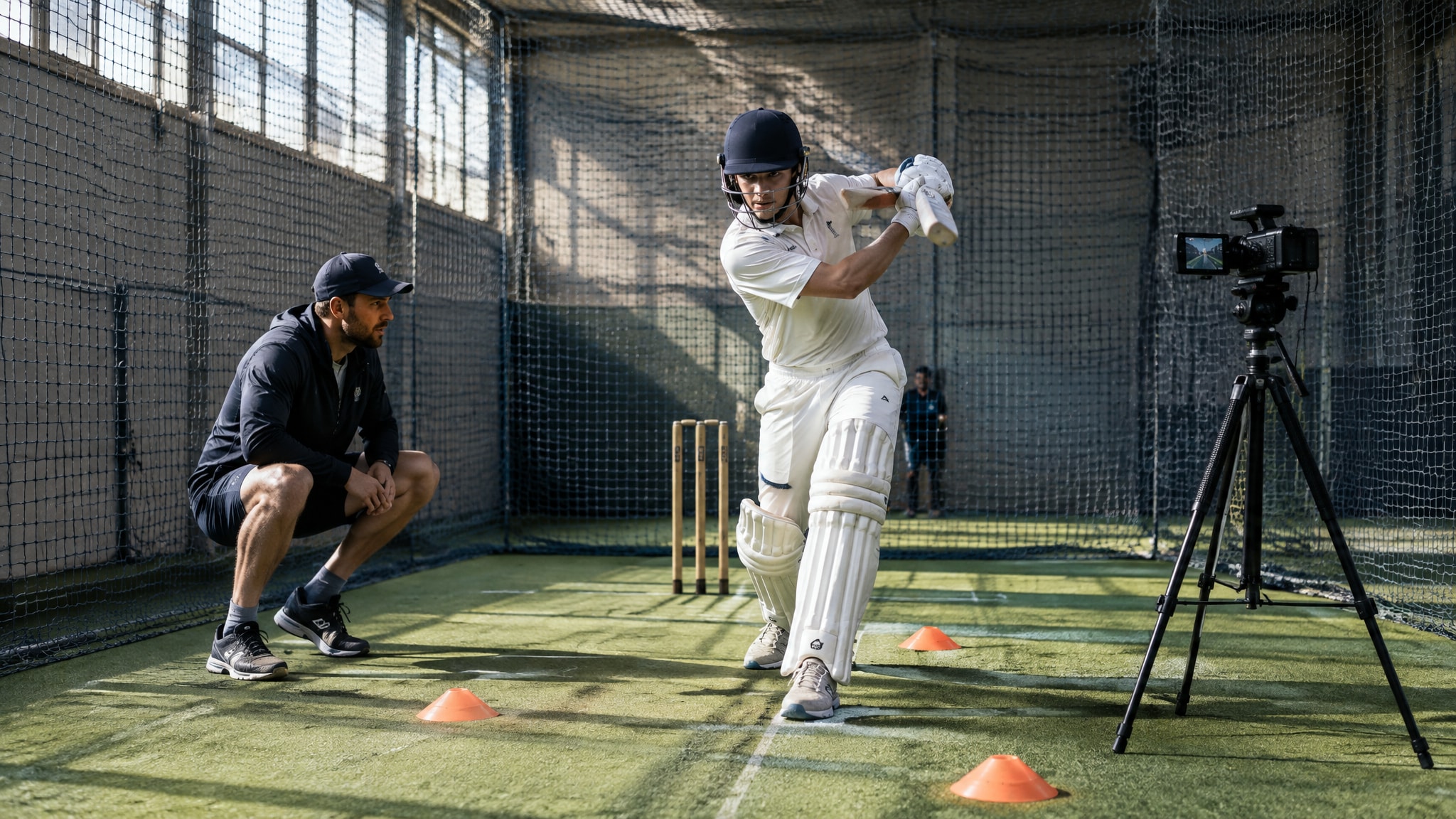
Most batting advice online is a list of tips: keep your head still, watch the ball, play straight. It's true, and it rarely fixes anything, because the tip never tells you what your head, feet and bat are doing. Cricket batting technique correction coaching starts from the opposite end. A coach looks at how you actually bat, picks out the fault that costs you the most runs, and works on it until it holds under pressure.
This page explains how that works at PlayCricket, what the common faults look like, and how to judge a coach before you book.
What Batting Technique Correction Coaching Involves
Technique correction means diagnosing one or two faults from video and the nets, then rebuilding them through repetition. It is narrower than general cricket batting lessons, which usually cover a bit of everything: grip, shot selection, running between the wickets, match awareness. Those lessons have their place. Correction coaching is for the batter who already knows something is wrong and wants it gone.
A typical session runs in this order:
- Assessment. You bat in the nets while the coach watches and notes where the faults show up.
- Footage. Your batting is filmed so the fault can be replayed at slow speed.
- Review. You and the coach watch the clips together and agree on the one or two things to change.
- Drills. You practise the new movement in controlled conditions, then against faster deliveries.
- Take-home plan. You leave with a written practice plan for the days between sessions.
The focus on one or two faults is deliberate. A batter who tries to change stance, footwork and backlift at once usually ends up worse for a few weeks, so the work is kept small enough that you can actually feel the change.
This is not a full technique rebuild in a single hour, and it won't suit a batter who wants a quick fix without practising between sessions.
Common Batting Technique Faults Coaches Correct
Every fault leaves a visible trace, either on video or in how the ball comes off the bat in the nets. Learning to read those traces is most of the coach's job, and it helps if you can read a few of them yourself before you walk in.
Faults also connect. A head that falls over often starts with a stance that leaves you off balance, and a gap between bat and pad often starts with a backlift that goes the wrong way. Fixing the downstream symptom without the cause is how batters end up in the same lesson year after year.
How to Fix a Batting Stance That Breaks Down
A stance is a setup, so you can check it before the bowler runs in. Four checkpoints cover most of it:
- Balance. Weight sits evenly over both feet, with knees slightly soft. If you rock back on your heels, you will be late forward.
- Head position. Eyes level, head still and over the line between the two feet. A tilted head makes every ball look like it is moving.
- Feet. Roughly shoulder-width apart, parallel to the crease. Feet that start too wide or too narrow limit how far you can move.
- Hands and grip. Hands relaxed and close together on the handle, bat grounded near the back foot, so the backlift starts from a settled position.
The sign of a stance that is breaking down is usually movement before the ball is bowled: shuffling, rocking, or a bat that wanders. On side-on footage you can see it in the first second of the clip, long before the delivery arrives.
The correction is usually a small change to one checkpoint, held for a set number of balls without drifting. Not every batter needs the same stance. A tall opener and a compact middle-order player will set up differently, and the coach should be correcting a fault, not forcing everyone into one template.
Footwork and Bat-Path Faults Coaches See Most
Three faults come up again and again.
The head drifting away from the line. Watch the head at the point of delivery. If it falls towards the off side or leans back, the eyes stop tracking the ball cleanly. The fix is usually earlier balance and a still head through the first movement, not "keep your head still" as an instruction.
The front foot landing across the line. Take a typical case: a batter keeps playing across the line of full-length balls, with the front foot drifting across before the bat comes down. On side-on footage the front-foot direction is easy to see, so the correction can start with that one movement rather than the whole technique. Once the foot goes towards the ball instead of across it, the bat tends to follow a straighter path on its own.
A gap opening between bat and front pad. You will notice it when you are bowled through the gate, or when edges fall between bat and pad. It usually comes from the bat starting its downswing from the wrong angle, or from the front foot and bat arriving at different times. The coach works on bringing the bat down from a straighter backlift and matching it to the foot movement.
Backlift is worth its own check. A backlift that goes towards gully or second slip, instead of towards the stumps, often creates a looping downswing and a cross-bat shot.
Each of these is a pattern, not a diagnosis. A coach who tells you your problem is "always" the same one as the last batter has stopped looking.
Video Analysis in Batting Coaching: What the Footage Shows
A coach standing at the side of the net sees roughly what you feel: the shot, the sound, the result. What they can't reliably catch in real time is the timing of the front foot against the ball's release, or exactly where the head is at the moment of delivery. Those happen in fractions of a second, and slow footage makes them plain.
The second benefit is agreement. It is hard to argue with a clip of your own front foot pointing at cover when you were certain it was going straight. Video makes a fault easier to see and agree on, but it does not correct the technique on its own, and the correction still happens in the nets, ball by ball.
Camera Angles That Show Stance, Footwork and Line
Two camera positions cover most of what a session needs:
- Side-on. This shows stance, backlift and front-foot direction. It's where you see rocking, a front foot going across, and a backlift that points the wrong way.
- Behind the bowler. This shows the line of the bat and the head position at the point of delivery. It's where you see the bat coming down at an angle, and whether your eyes are level.
Some faults only show from one angle. A bat coming across the line is almost invisible side-on, and a front foot going across the line is easy to miss from behind. That is why one camera is rarely enough for you or for the coach.
Reviewing Footage With the Batter, Step by Step
Footage reviewed as a highlight reel teaches nothing. Reviewed properly, it follows a sequence:
- Watch the clip once at normal speed, so you see what the coach saw.
- Replay it slowly and pause at the point of delivery.
- Name the one thing to change, in words you would use yourself.
- Compare it with a later clip from the same session to see whether the change held.
You should leave the review able to describe your own fault out loud. If you can't, you won't catch it at the crease when nobody is filming.
Drills Used to Lock In a Corrected Technique
Drills are not a menu. The right drill depends on the fault in your footage, and a drill that fixes a front foot crossing the line does very little for a gap between bat and pad. PlayCricket's coaching team sets the drills for each batter, so treat the sequence below as a common pattern rather than a fixed routine.
A corrected movement is fragile at first. It works against a slow feed and falls apart as soon as the ball is quick or the pressure rises, which is why the drills are built to raise the difficulty gradually.
Progressing From Slow Reps to Live Balls
A common progression runs in four stages:
- Stance and balance with the bat grounded. No ball. You hold the setup and feel what balanced is.
- Front-foot movement against a marker. A cone or line on the floor shows where the foot should land, so you can check it without a coach watching.
- Throw-downs along the same line. The ball arrives at a speed that lets you repeat the new movement.
- Live balls, with the footage reviewed afterwards. This is the real test, because pressure brings old habits back.
Move to the next stage only when the current one feels boring. If the new movement still needs concentration, it isn't ready for faster balls.
You also need repetition between coached sessions, and that is hard to do in a garden. Booking an indoor net lane in Gauteng gives you somewhere to put the take-home plan to work.
Batting Technique Coach Expertise: What to Check Before You Book
A batting technique coach does one thing you can't do for yourself: see what you can't feel. So when you choose one, you're really checking how well they see and how well they explain.
Credentials give you part of the answer, but only part.
Accreditation and Coaching Experience to Ask About
Formal accreditation, such as Cricket South Africa's graded coaching levels, shows that a coach has completed structured coaching training. It does not, by itself, show that the coach can diagnose and correct a particular batter's fault. A well-qualified coach can still be poor at explaining, and an experienced club coach without a certificate can be excellent. If you want to see what that training looks like locally, read about CSA Level 2 coaches in Gauteng.
Whichever coach you book, ask what level they hold and when they qualified. Then add the questions that show how they actually work:
- How do you decide which fault to fix first?
- What will you film, and from where?
- How will you show me the fault, rather than just tell me?
- How will I know the change has held?
- What do I do between sessions?
A good coach answers these without hesitating, in plain words. If you are weighing options for a junior, the same questions apply, and there's a wider checklist in choosing a coach for a young batter.
Cricket Batting Improvement in Gauteng and Randburg
PlayCricket serves players in Gauteng and Randburg, and the practice environment matters more than most batters expect. Indoor nets give you controlled repetition: the same surface, the same length, no wind, no waiting for a pitch. That suits the early stages of correction, when you need to repeat one movement many times.
Outdoor practice adds live conditions. The ball behaves differently on grass, the light changes, and you have to react to a bowler instead of a machine or a throw-down. Both have a job, and the trade-offs are covered in more depth in this piece on indoor versus outdoor net practice.
Confirm the venue for your session when you book, since it will depend on the format you choose.
Booking Your Batting Technique Session at PlayCricket
You've now seen what a session involves, so the last step is choosing how to book it. Pick the fault you most want fixed and book against that, rather than against a vague wish to "get better".
What to Prepare Before You Book
Three things make the first session far more useful:
- A short clip of your own batting. Even a phone video from the side of the net, filmed side-on, gives the coach something to start from. Thirty seconds of you facing a few balls is plenty.
- Your kit. Bring the bat, pads, gloves, helmet and box you actually play in, so the coach sees your real setup and not a borrowed one.
- One sentence on the problem. "I keep getting out lbw" or "I'm bowled through the gate" is more useful than "my batting is bad".
Choosing a One-on-One Session or an Ongoing Program
A single one-on-one session suits a batter with one clear fault and a match coming up, or someone who wants an honest assessment before committing further. An ongoing program suits a batter who has several linked faults, or whose corrected technique needs reviewing as it meets faster bowling.
If you're unsure, start with one session. You'll know within an hour whether the way the coach works suits you, and the take-home plan tells you how much more work the fault needs. For formats and costs, see Randburg coaching programs and pricing.
When you're ready, book a one-on-one batting session in Gauteng and attach your clip.
Frequently asked questions
How many sessions does it take to fix a batting fault?
There is no fixed number. It depends on how long the habit has been in your game and how often you practise the take-home plan between sessions. A single clear fault, such as a front foot crossing the line, is often the easiest to start on in one session, while linked faults usually need an ongoing program.
Do I need video footage of myself before I book?
No, but a short clip helps. A phone video taken side-on at the nets, showing a few balls, gives the coach a starting point. Footage is also captured during the session itself, so you can still book without one.
Is a batting technique session different from ordinary cricket batting lessons?
Yes. General lessons cover a range of skills, while technique correction focuses on one or two faults found on video and in the nets. You then repeat the fix through drills until it holds against live balls.
Does a coach's accreditation guarantee they can fix my batting?
No. Accreditation, such as Cricket South Africa's graded levels, shows the coach has completed structured training. It does not show they can diagnose your particular fault, so ask how they find a fault, what they film and how they explain it.
Should I practise indoors or outdoors after a session?
Start indoors. Nets let you repeat one movement in controlled conditions while the correction is still new. Move outdoors once the movement feels automatic, because live conditions test whether it holds.