Most South African parents pick a cricket coach the same way they pick anything for their kids: a friend mentions a name, the session times fit the week, and the fee seems fair. That works until your child starts dreading Saturday mornings or comes home with a sore back. This guide on how to choose a cricket coach for your child puts the questions in the order that matters. Start with age and stage, then credentials, then character, then a trial.
It is written for parents of club and school-level players, not for families chasing a franchise contract.
Choosing a Cricket Coach for Your Child's Age and Stage
A good coach for a seven-year-old is not automatically the right coach for a sixteen-year-old. Accepted youth coaching practice puts basic skills, enjoyment and repetition ahead of results for young players, and gives technique and match management more weight as they grow. So the first thing to settle is what your child needs right now.
Age-Appropriate Basics for Primary-School Players
At this age the coach's job is to make children want to come back. Look for games-based sessions where everyone bats, bowls and fields within the first half hour, rather than long queues behind a net.
The cricket content should still be real. A coach working with young children should be teaching a sound grip, a balanced stance, soft hands for catching, and a proper throwing action, because habits formed at eight are hard to undo at fourteen.
Bowling action can be introduced simply, with the focus on rhythm and a straight run-up rather than pace. Batting technique at this stage means watching the ball and playing straight, not collecting a full set of shots.
If a coach talks about winning leagues with under-9s, treat that as a signal about priorities, not ambition.
What Teenage Players Need, Especially Fast Bowlers
Teenagers need more precise work. That means refining the batting technique they already have, learning to read match situations, and understanding field placings, running between the wickets and when to change tempo.
Fast bowlers need extra care. Bowling workload is a widely recognised concern for developing quicks, and coaches who keep track of spells and overs are following accepted practice. A coach who also involves medical staff when a young bowler reports pain is doing it properly, while one who says "bowl through it" is not.
Your teenager will also have opinions about the coach, and you should listen to them. A fifteen-year-old who feels heard will work harder than one who is simply told what to do.
Cricket Coach Credentials: What CSA Qualifications Tell You
Cricket South Africa runs a graded coaching-education pathway, and CSA Level 2 is one named rung of it. That gives you something concrete to ask about instead of accepting a vague claim that someone is "fully qualified". Level names and course content change from time to time, so check the current structure with Cricket South Africa or the coach's course provider if you are unsure what a level means.
A qualification signals structured, cricket-specific training, but it does not tell you whether that coach will suit your particular child.
What a CSA Qualified Coach Should Be Able to Show
Ask which level the coach holds, roughly when they completed it, and what the course covered. A coach with a CSA qualification should be able to answer in plain terms: whether it included coaching young children, bowling actions, session planning and safety. Most coaches are happy to talk about it, and vagueness is worth noting.
If you want to see how this plays out locally, our guide to CSA Level 2 coaches in Gauteng explains who to book and what to check.
Remember what a certificate cannot do. It proves a coach completed training, not that they are patient, fair or good with a shy nine-year-old, which is why credentials are only one input alongside the people skills and trial session covered below.
Credentials Beyond the Cricket Certificate
A cricket certificate says nothing about whether your child is safe. Three other credentials matter just as much, and you are entitled to ask for each:
- Current first aid. Cricket balls are hard, and a coach should know what to do in the first minutes after a knock to the head or a dislocated finger.
- Child-safeguarding training. This covers how adults should behave around children, how concerns are reported, and who is accountable.
- A police clearance or criminal record check. Ask whether one is on file and how recent it is.
Ask politely and without apology, because a coach who takes children seriously will have answers ready. Any hesitation is information.
Qualities of a Good Cricket Coach
Some of the most important traits never appear on a certificate. A good youth coach is patient, explains things clearly, treats the weakest player in the group with the same attention as the strongest, and stays calm when a child drops a catch or bowls a wide.
A strong playing record does not guarantee good teaching. Plenty of excellent players cannot explain what they do, and some of the best youth coaches never played above club level.
The question is whether this person can break a skill into steps a ten-year-old understands, and whether you can see that happen on the field.
Youth Cricket Coaching Tips Worth Watching For
You can see these habits from the boundary rope in one session:
- Specific praise. "Good, your front foot went straight to the ball" teaches more than "well done".
- One correction at a time. A child told to fix grip, stance and head position in one go will fix none of them.
- Reasons given. The coach says why a technique matters, such as why a high elbow helps a straight drive, so the child learns to think.
- Mistakes handled calmly. A dropped catch becomes the next drill, not a public lecture.
Ask for a Trial Session Before You Commit
A trial shows you how a coach teaches, and that matters more than any claim about coaching ability. Ask whether you can watch, and whether your child can attend a session or two before you pay for a full season. A coach confident in their work will usually say yes without fuss.
What to Watch During the Session
Stand where you can see the whole group and keep your attention on the process, not the cricket shots themselves.
Check that every child gets repeated turns, so nobody spends twenty minutes waiting. Notice whether corrections are specific and calm. Watch how batting and bowling are spaced, with nets and run-ups set up so nobody can be hit by a stray ball or a throw.
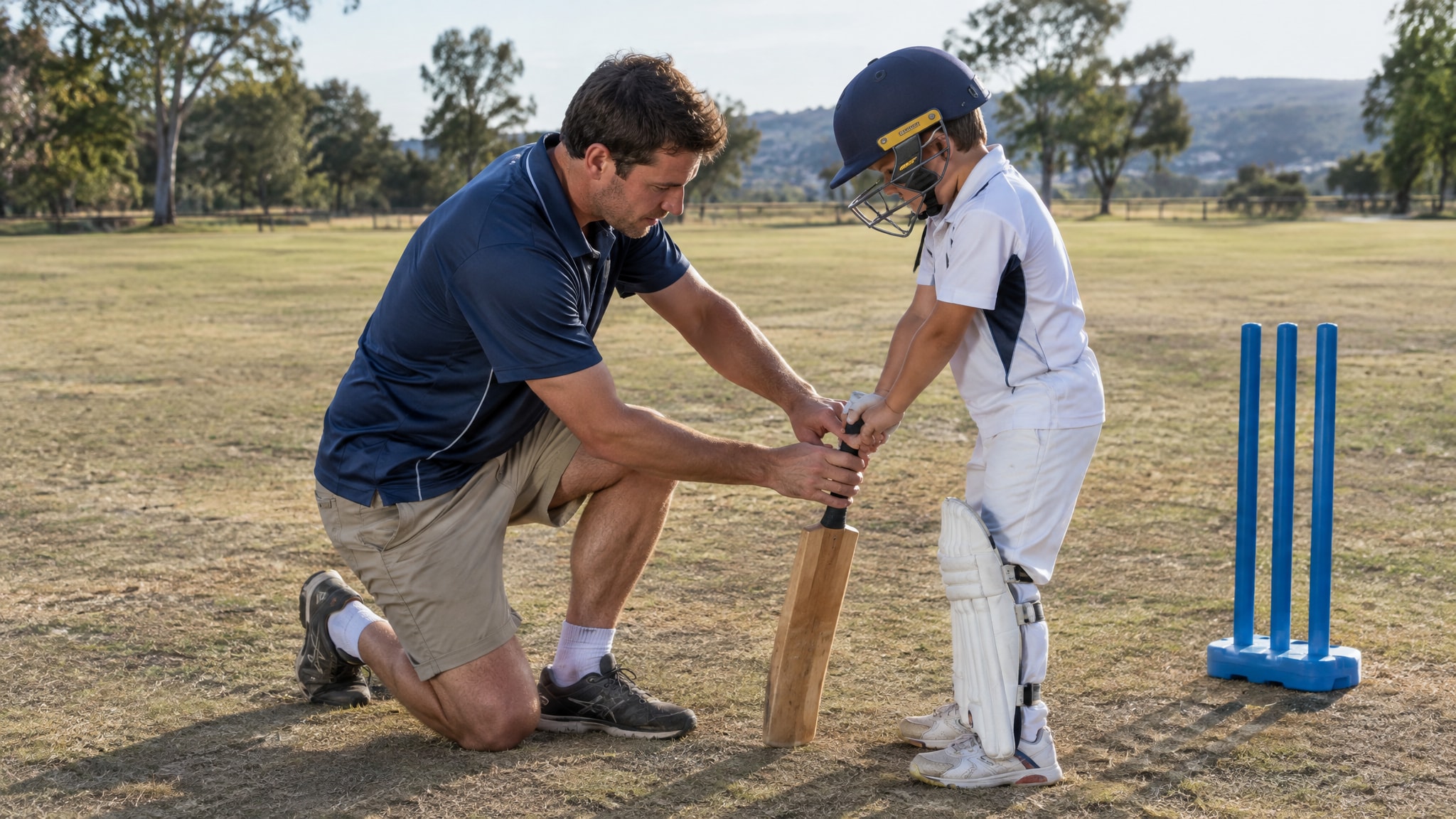
Look at the kit as well. Bats should suit the child's size and strength, and helmets, pads and boxes should fit properly where they are required. Gear that is too heavy or too big teaches bad technique and risks injury.
How to Read Your Child's Reaction Afterwards
Wait until you are home, then ask what they learned and whether they want to go back. Children usually answer honestly when the question is open.
Don't judge on one session. A child may be tired, nervous about new faces, or simply having an off day, so give it two or three before deciding. Real fit shows up over several weeks as growing confidence, not as a single excited car ride home.
Questions to Ask a Coach Before You Commit
You don't need a long checklist. A handful of cricket-specific questions will show whether a coach is serious about young players, and the answers matter more than how smoothly they are delivered.
Questions About Experience, Safety and Parent Updates
- Experience: "What age groups have you coached, and what do you work on first with a child my son or daughter's age?"
- Bowling workload: "How do you manage overs and spells for young bowlers, and what do you do if one reports pain?"
- Safeguarding: "What is your safeguarding process, and can I see your first aid and clearance details?"
- Updates: "How will I hear about my child's progress, and how often?"
- Fees: "What does the fee cover, and what does a full season include?"
On that last point, fees vary widely between clubs, academies and private coaches, so what cricket coaching costs in South Africa is worth reading before you compare quotes. A coach should be able to tell you in plain terms what is included and what is extra, such as kit, tournaments or additional sessions.
Red Flags That Should Send You Looking Elsewhere
Some warning signs are clear-cut. Shouting at children or shaming them in front of teammates is one. So is pressure to specialise in cricket early, when a young child should still be trying other sports. Be wary of promises of selection or results, because no coach controls who gets picked. Also watch for no visible first aid or safeguarding, unclear fees, and young bowlers pushed through long, heavy spells.
You should not treat every concern as a dealbreaker, though. A single oddity deserves a follow-up question: perhaps the coach was having a bad day, or the first aid kit was in the car. Ask, then see whether the answer is reasonable.
A pattern is different. If you see two or three of these across several sessions, or the coach answers your questions with irritation, walk away.
Nothing here replaces your own judgement of your child. A coach can tick every box and still be wrong for a particular player, and you are allowed to leave.
Finding CSA Qualified Coaches in Gauteng
Gauteng parents generally choose between three options, and they suit different children and budgets. Clubs usually offer a team setting and a chance to play matches, often at a lower cost. Academies tend to offer more structured programmes with several age groups. Private coaches give one-on-one attention and flexibility, but usually cost more per hour and don't give your child a team around them.
Our comparison of academy or club coaching in Randburg goes through the trade-offs in more detail, and if you are looking at structured programmes, the list of junior cricket academies across Gauteng helps you build a shortlist. Whichever route you take, ask for the credentials covered above, including the CSA level and the safeguarding details.
The 2026 season is already under way, so don't assume places are open. Ask about places and start dates for 2027 now, because the better groups often fill early.
When you are ready to compare options, start with PlayCricket's Randburg coaching programmes and pricing, then ask about a trial session for your child.
Frequently asked questions
Does my child's cricket coach need a CSA qualification?
Not by law, but a CSA qualification shows the coach has had structured, cricket-specific training, and it gives you a concrete level to ask about. It does not prove they are right for your child, so weigh it alongside first aid, safeguarding training, a police clearance and how they teach in a trial session.
At what age should a child start cricket coaching?
Primary-school age is fine, provided the sessions are games-based and fun. At that stage the coach should be teaching grip, stance, catching and throwing, not chasing results. Serious technique work and match awareness belong to the teenage years.
How do I know if a coach is overbowling my son?
Ask the coach how they track overs and spells, and watch whether a young bowler is kept going when tired. If your son reports pain, a good coach stops him and involves medical staff. A coach who tells him to push through is a reason to look elsewhere.
How many trial sessions should my child attend before I commit?
Aim for two or three. One session can be skewed by nerves or tiredness, but a few weeks show whether your child is gaining confidence and wants to go back. Ask the coach upfront whether you can watch and whether a trial is possible before paying for a season.
Is a former professional player automatically a good youth coach?
No. Playing at a high level doesn't guarantee someone can explain a skill to a ten-year-old, stay patient, or treat weaker players fairly. Judge the coach by what you see at a session, not by their playing record.